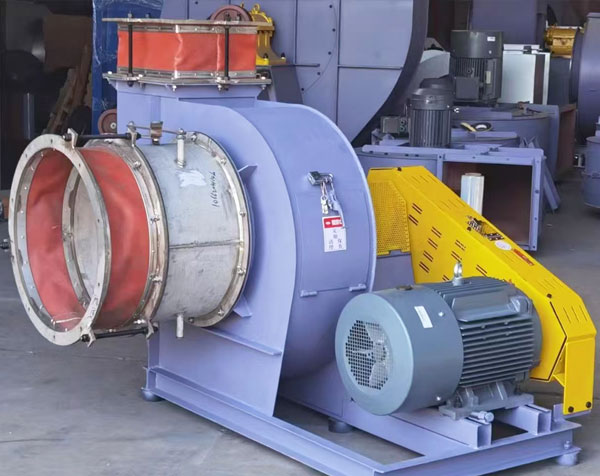

When I design or select a dust fan for an industrial ventilation system, I do not look at the fan alone. I look at the whole working condition: airflow, pressure, dust type, temperature, operating time, duct resistance, installation space, and maintenance requirements. A fan that looks suitable on paper may perform very differently once it is connected to a real dust collection system.
Our Belt-Drive Dust Fan is developed for this kind of practical industrial application. It is designed to provide stable airflow and pressure for dust removal, exhaust, and waste gas treatment systems. The belt-drive structure gives us useful flexibility when the required fan speed needs to be adjusted for a specific working condition. Depending on the application, we can also discuss wear-resistant, corrosion-resistant, high-temperature-resistant, or explosion-proof configurations.
At Zhejiang Shangyang Industrial Fan Co., Ltd., we manufacture standard and non-standard industrial fans for coating, dust collection, building materials, metallurgy, chemical processing, new energy, powder handling, and other industrial applications. My approach is simple: first understand what the fan has to do, then select the structure and materials around that requirement.
1. What Is a Belt-Drive Dust Fan?
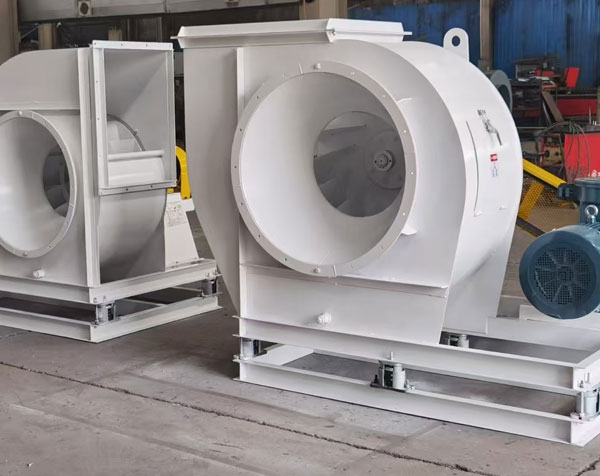
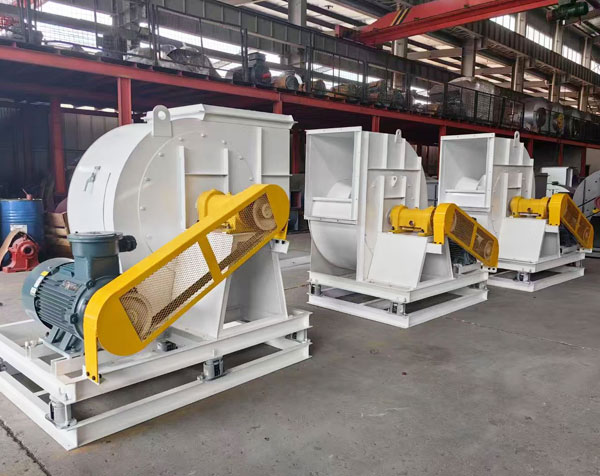
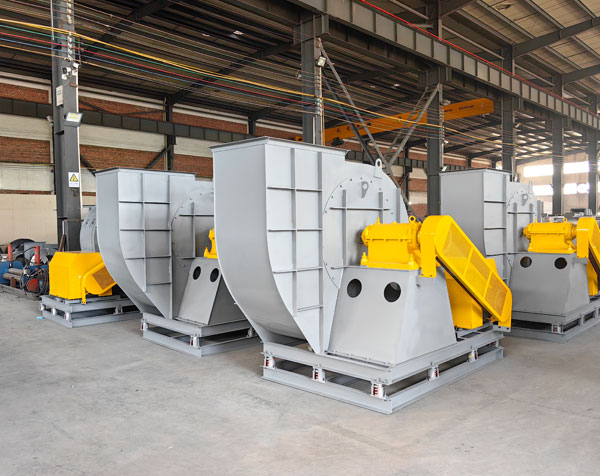
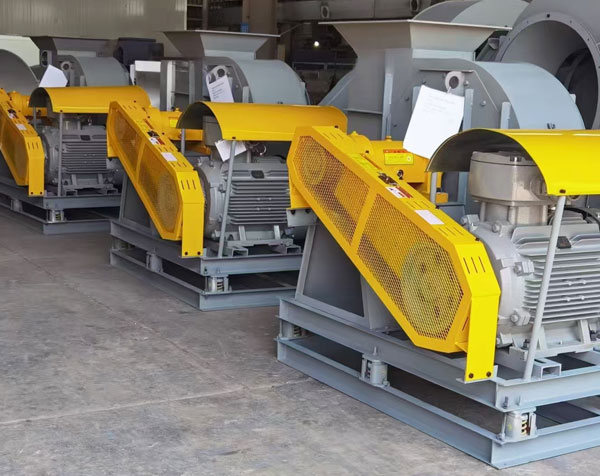
A belt-drive dust fan is an Industrial Ventilation Fan that uses a motor, belt, pulley, shaft, and impeller to move air, dust-laden gas, or process exhaust. Unlike a direct-drive fan, the motor does not directly connect to the fan impeller shaft. Power is transferred through the belt and pulley system.
That may sound like a small difference, but it can be useful in industrial equipment. The pulley ratio gives us more freedom to match the fan speed with the actual process requirement. In some projects, the fan does not need to run at the same speed as the motor. A belt-drive arrangement lets us select a suitable transmission ratio during the design stage.
I normally recommend starting with the actual operating point rather than choosing a fan simply because its motor power looks large enough. The two basic questions are: how much air needs to be moved, and how much resistance must the fan overcome? The answer depends on the duct system, filter, cyclone, scrubber, dust collector, process equipment, bends, dampers, and other components connected to the fan.
This is also why airflow and pressure should be considered together. The American Air Movement and Control Association explains that fan performance ratings are based on factors such as airflow, pressure, power, air density, rotational speed, and efficiency. In practical system design, the installed system can also reduce fan performance because of system effects. :contentReference[oaicite:0]{index=0}
Our Belt-Drive Dust Fan is therefore not treated as a simple air-moving machine. We consider it part of the complete dust extraction or industrial exhaust system.
Typical operating considerations
Required airflow volume
Required static or total pressure
Dust concentration and particle characteristics
Gas temperature
Gas corrosiveness
Continuous operating time
Required fan speed
Motor power and voltage
Installation position and available space
Duct and dust collector resistance
For a standard project, we can supply a suitable configuration based on the customer's operating conditions. For a non-standard project, we prefer to confirm the working conditions before production rather than make a quick assumption.
2. How Our Belt-Drive Dust Fan Works
The working principle is straightforward. The motor produces mechanical power. That power is transferred to the fan shaft through the belt and pulley system. The shaft rotates the centrifugal impeller, and the rotating impeller draws gas into the fan inlet. The gas is accelerated outward by centrifugal force and discharged through the outlet into the connected duct or treatment equipment.
In a dust collection system, the fan is often installed downstream of the dust collector or filtration equipment, depending on the process design. Its job is to create the pressure difference needed to keep the air moving through the system.
In other installations, the fan may be used as an exhaust or induced-draft fan. The exact position depends on the process. I always recommend checking the complete system before deciding where the fan should be installed.
The belt-drive arrangement has another practical advantage: speed can be matched through the pulley arrangement. If the process requires a different fan speed, the transmission design can be adjusted within the permitted operating range. This makes belt-drive fans useful when the process has particular airflow and pressure requirements.
Of course, speed adjustment should not be treated casually. Changing fan speed changes airflow, pressure, power demand, and mechanical loading. For this reason, the final fan selection should be based on the required duty point and the manufacturer's operating range.
Why the system matters as much as the fan
One common mistake I see in fan selection is focusing only on the fan's free-air capacity. A dust collection system is rarely a free-air application. The air has to travel through ducts, elbows, filters, collectors, dampers, and sometimes additional treatment equipment.
AMCA Publication 201 specifically discusses the difference between laboratory fan performance and actual installed system performance and notes the importance of system effect factors. In simple terms, the fan may perform well in a test setup but lose performance if the connected system is poorly designed. :contentReference[oaicite:1]{index=1}
This is why our technical communication with customers normally starts with operating conditions. If a customer gives us airflow, pressure, temperature, medium, and operating time, we have a much better basis for selecting the fan.
| Parameter | Why It Matters | Typical Information We Need |
|---|---|---|
| Airflow | Determines how much gas the system needs to move | m³/h, m³/s, or CFM |
| Pressure | Determines whether the fan can overcome system resistance | Pa, kPa, or in. w.g. |
| Temperature | Affects materials, bearings, seals, motor arrangement, and fan construction | °C or °F |
| Medium | Determines material and wear or corrosion requirements | Dust, gas, vapor, particles |
| Operating time | Influences mechanical design and durability requirements | Hours/day or continuous duty |
| Installation | Affects fan arrangement, inlet, outlet, drive position, and maintenance access | Layout and installation conditions |
Source: Selection framework based on the product configuration information supplied for this product and AMCA fan performance guidance. AMCA identifies airflow, pressure, power, density, speed, and efficiency as important fan-performance parameters. :contentReference

3. Main Features of Our Belt-Drive Dust Fan
The first thing I focus on in a dust fan is stable operation. Dust removal systems often run for long periods, and an unstable fan can affect the entire production line. Our Belt-Drive Dust Fan uses a reinforced industrial structure and can be configured according to the working medium.
Wear-resistant construction
Dust is not always gentle on equipment. Hard particles moving through the system can gradually wear the impeller and internal surfaces. For applications with abrasive dust, the material and protective design need to be considered carefully.
We can discuss wear-resistant configurations according to the actual dust characteristics. Particle size, concentration, hardness, velocity, and operating hours all matter. There is no single material that is automatically correct for every dust application.
Corrosion-resistant options
Some exhaust gases contain corrosive components. In these cases, ordinary carbon steel construction may not be the best choice. Depending on the medium, we can consider suitable corrosion-resistant materials or protective treatment.
The important point is that material selection should follow the actual gas composition and operating temperature. I do not recommend choosing stainless steel or another material simply because it sounds stronger. The right choice depends on the process.
Stable air pressure
Dust collection equipment often requires a certain pressure level to overcome resistance from filters, ducts, cyclones, scrubbers, and other components. Our fan is designed around the customer's required operating point so that airflow and pressure are considered together.
Flexible belt-drive structure
The belt-drive structure gives the fan more flexibility in speed matching. It can be useful when the required impeller speed differs from the standard motor speed or when the system needs a particular transmission ratio.
Optional high-temperature and explosion-proof configurations
Some dust and exhaust applications involve higher temperatures or potentially hazardous dust. For these projects, the fan configuration needs additional engineering consideration. We can discuss high-temperature-resistant or explosion-proof options according to the actual working conditions.
I want to make one point especially clear: an explosion-proof requirement should never be treated as simply changing the motor. The entire system, including the dust characteristics, electrical equipment, grounding, pressure relief, and installation environment, needs to be assessed according to applicable local requirements.
OSHA guidance on combustible dust notes that dust collection systems and related equipment may require appropriate explosion prevention, suppression, or pressure-relief measures depending on the hazard. It also emphasizes preventing dust leakage and accumulation. :contentReference[oaicite:3]{index=3}
| Working Condition | Recommended Design Focus | Possible Configuration |
|---|---|---|
| General industrial dust | Stable airflow and pressure | Standard industrial construction |
| Abrasive dust | Reduce wear on airflow-contact components | Wear-resistant materials or protection |
| Corrosive exhaust | Resist chemical attack | Corrosion-resistant material selection |
| High-temperature gas | Control heat transfer and component temperature | High-temperature-resistant configuration |
| Potentially hazardous dust | Control ignition and explosion risks | Explosion-proof configuration and suitable system protection |
Source: Product configuration information supplied by Zhejiang Shangyang Industrial Fan Co., Ltd.; safety considerations referenced against OSHA combustible-dust guidance. Final configuration must be confirmed from the actual process conditions and applicable local regulations. :contentReference[oaicite:4]{index=4}
4. Where Can a Belt-Drive Dust Fan Be Used?
Our Belt-Drive Dust Fan is mainly used where dust, particles, process gas, or exhaust air needs to be moved through an industrial ventilation or dust collection system. Because working conditions vary so much from one factory to another, we do not limit the product to one industry.

Building materials
Cement, lime, gypsum, stone, ceramic raw materials, and other building-material processes can generate a large amount of dust. A properly selected Industrial Dust Fan can help move dusty air toward filters or other treatment equipment.
Metallurgy
Metal processing may involve hot air, smoke, dust, and fine particles. Depending on the process, the fan may be designed for higher temperature, abrasion, or corrosion resistance.
Chemical processing
Chemical plants can have very different exhaust conditions. Some gases may be corrosive, while others may require special temperature or safety considerations. In this industry, I pay particular attention to the actual gas composition rather than selecting a fan based only on airflow.
Coating and painting
Coating production lines need controlled ventilation to remove process exhaust and maintain suitable airflow. Our industrial fan experience includes coating equipment and environmental protection applications.
Powder processing
Powder handling can generate fine particles that need controlled collection. Depending on the material, combustible-dust considerations may apply. The fan should therefore be selected together with the dust collector and safety system.
New energy manufacturing
New energy production lines can involve dust, process gases, drying operations, and exhaust treatment. The correct fan configuration depends heavily on the individual production process.
Environmental protection projects
This is one of the most direct applications. The fan can serve as an important air-moving component in dust removal and waste gas treatment systems. It may be used together with bag filters, cartridge filters, cyclones, scrubbers, or other treatment equipment.
AMCA's field-performance guidance covers fan applications including industrial processes, exhaust, conveying, drying, air cleaning, and dust collection. This matches the broad role industrial fans can play across different process systems. :contentReference[oaicite:5]{index=5}
| Industry | Typical Application | Main Fan Concern |
|---|---|---|
| Building materials | Dust collection and process exhaust | Dust load and wear |
| Metallurgy | Fume and dust extraction | Temperature and particles |
| Chemical | Waste gas ventilation | Corrosion and medium composition |
| Coating | Paint and process exhaust | Airflow stability and safety |
| Powder processing | Dust extraction | Fine particles and possible dust hazards |
| New energy | Process ventilation and dust control | Process-specific gas conditions |
Source: Application examples based on the product information supplied by Zhejiang Shangyang Industrial Fan Co., Ltd., with general fan application scope cross-checked against AMCA industrial fan guidance. :contentReference[oaicite:6]{index=6}
5. How We Manufacture and Test the Fan
A good industrial fan starts long before the impeller is assembled. For us, manufacturing begins with the operating data. We need to know the required airflow, pressure, temperature, medium, operating time, installation method, and other important conditions.
Once the working condition is confirmed, the fan structure and materials can be selected. Standard products follow our established manufacturing process, while non-standard products are adjusted according to the customer's actual requirements.
Step 1: Confirm the operating condition
We review airflow, pressure, temperature, medium, installation space, motor requirements, and operating schedule. If the information is incomplete, the selection becomes less reliable. This is why I prefer to spend more time on the front end rather than solve problems after delivery.
Step 2: Fan design
Our technical team designs the fan structure around the selected operating point. The impeller, casing, shaft, bearing arrangement, drive system, and other components are considered as a complete unit.
Step 3: Material and component preparation
Materials are selected according to the working environment. For abrasive, corrosive, or high-temperature conditions, the material requirements can be different from those of a standard dust fan.
Step 4: Fabrication and assembly
Components are processed and assembled according to the design. Particular attention is given to the impeller, shaft, belt-drive arrangement, casing, and connection dimensions because these components directly affect fan operation.
Step 5: Inspection and testing
Before shipment, we conduct operation and performance-related checks according to the agreed requirements. Temperature rise and operating conditions are also checked where applicable.
The purpose of testing is not simply to make the machine run. We want to confirm that the delivered product matches the agreed technical requirements. AMCA's current fan testing standard similarly emphasizes uniform laboratory methods for determining aerodynamic performance such as airflow, developed pressure, power, air density, rotational speed, and efficiency. :contentReference[oaicite:7]{index=7}
For customers who require specific testing documents, the available reports and documentation can be discussed before the order is confirmed.
Our normal production and delivery process
Customer provides working conditions and technical requirements.
We confirm fan selection and configuration.
Technical specifications are agreed.
Production is arranged after order confirmation.
Standard models normally require approximately 7–15 working days.
Non-standard models are scheduled according to materials, size, and customization.
Operation and performance checks are completed before shipment.
Test report and parts list are supplied according to the agreed delivery requirements.
The fan is packed and shipped according to cargo size and destination.
6. Delivery, Payment, Transportation, and Packaging
For an industrial fan, delivery is not finished when the machine leaves the factory. The equipment still has to reach the customer's site safely. Large fans can have unusual dimensions and weight, so transportation planning matters.

Production cycle
Our standard production cycle is generally 7–15 working days. This applies to standard models after the technical details and order requirements are confirmed. Customized fans, special materials, unusual dimensions, or special working conditions may require additional production time.
Delivery standard
Delivery is based on the agreed technical specification and industry requirements. Depending on the project, documentation can include a test report and parts list. The exact documents should be confirmed when the order is placed.
Payment method
Our normal payment method is bank transfer. For customized industrial equipment, the specific deposit and balance arrangement is confirmed in the sales contract. For the dust fan products described here, the typical arrangement is a deposit followed by balance payment before shipment.
Transportation
Domestic transportation can be arranged by full truckload or less-than-truckload logistics depending on the equipment size and destination. For overseas orders, container sea freight can be used when suitable.
Packaging
We use stretch film to protect the complete machine from dust and moisture. Important components are additionally protected with wooden crates or other suitable packing materials where necessary. The purpose is simple: reduce the risk of moisture, impact, collision, and movement during transportation.
For large industrial equipment, I also recommend confirming unloading conditions before shipment. The customer should know the approximate cargo dimensions, weight, lifting points, and site access requirements in advance.
7. Why I Recommend Working With Shangyang Fan
I believe the biggest difference between an ordinary industrial fan supplier and a useful technical supplier is not simply the appearance of the product. It is whether the supplier understands what happens after the fan leaves the factory.
Zhejiang Shangyang Industrial Fan Co., Ltd. has dedicated fan design, manufacturing, and sales teams with around 20 years of industry experience. Our factory in Jinyun, Zhejiang, manufactures standard and non-standard industrial fans for a wide range of process applications.
Our product range includes Centrifugal Fans, High-Temperature Fans, induced draft fans, axial fans, Low-Noise Centrifugal Fans, High-Pressure Fans, stainless steel centrifugal fans, hot air circulating fans, mixing fans, and explosion-proof centrifugal fans.
We have built our experience around coating fans and environmental protection fans and have continued to improve product design and manufacturing over many years. We also have national test reports for specialized products and have obtained certifications including explosion-proof and energy-efficiency certifications for applicable products.
For a Belt-Drive Dust Fan, this background is useful because dust removal is rarely a one-size-fits-all application. A fan for dry powder is not necessarily the same as a fan for hot flue gas. A fan for abrasive particles is not automatically suitable for corrosive gas. A fan for a standard ventilation system may not be appropriate for a hazardous dust environment.
My recommendation is always to start with the process. Tell us what the fan needs to move, how hot it is, how much air is required, how much pressure is needed, how many hours it will operate, and what equipment is connected to it. From there, we can work toward a more suitable configuration.
We also support non-standard industrial fan production. This matters when the existing equipment layout does not match a standard catalog model or when a customer has specific installation dimensions, materials, drive arrangements, or process requirements.
Our products are used across China and are also supplied to overseas customers as supporting equipment. For export projects, transportation and packaging requirements can be discussed based on the destination and cargo dimensions.
8. Belt-Drive Dust Fan FAQ
What is the main advantage of a belt-drive dust fan?
The main practical advantage is transmission flexibility. The motor and fan shaft are connected through belts and pulleys, allowing the transmission ratio to be selected according to the required fan speed. This can be useful in industrial systems where the required fan speed does not directly match the motor speed.
Is a Belt-Drive Dust Fan suitable for continuous operation?
It can be designed for continuous industrial operation when the fan, motor, bearings, belt system, materials, and cooling arrangement are correctly selected for the actual working condition. Continuous operation should be specified during the selection process rather than assumed after installation.
Can the fan handle abrasive dust?
Yes, suitable wear-resistant configurations can be considered for abrasive dust applications. The correct solution depends on particle size, dust concentration, hardness, gas speed, temperature, and operating hours.
Can the fan handle corrosive gas?
Corrosion-resistant material or protective treatment can be considered for suitable applications. We need the gas composition, concentration, temperature, humidity, and operating conditions before confirming the material selection.
Can you provide a high-temperature version?
Yes. High-temperature-resistant configurations can be discussed according to the actual gas temperature and operating conditions. The final design may involve different materials, bearing arrangements, insulation, cooling, or other structural changes.
Can the dust fan be made explosion-proof?
Explosion-proof configurations can be discussed for applicable projects. However, the correct solution depends on the hazardous environment, dust characteristics, electrical classification, and applicable safety requirements. A fan should not be called explosion-proof simply because an explosion-proof motor has been installed.
How do I select the right dust fan?
Start with six basic pieces of information: airflow, pressure, temperature, medium, operating time, and installation conditions. If available, also provide the dust collector model, duct size and length, filter resistance, gas composition, and motor power requirements. These details allow us to make a much more useful selection.
What is the normal production time?
Standard models normally take approximately 7–15 working days after technical details and order requirements are confirmed. Customized models may require additional time depending on size, materials, and special requirements.
How is the fan packaged?
The complete fan is normally protected with stretch film, while important components can be placed in wooden crates or given additional shock and moisture protection. The packaging method is adjusted according to equipment size and transportation conditions.
How is the fan transported?
Domestic shipments can use full-truckload or less-than-truckload logistics. Overseas shipments can be arranged by container sea freight where suitable. The exact method depends on cargo dimensions, weight, destination, and customer requirements.
Final Thoughts: Selecting a Dust Fan Based on the Real Working Condition
After years of working with industrial fans, I have found that fan selection becomes much easier when we stop asking, “Which fan is the biggest?” and start asking, “What exactly does this fan need to do?”
A good Belt-Drive Dust Fan should match the system's airflow and pressure requirements. It should also suit the temperature, dust type, gas composition, operating time, and installation environment. The belt-drive arrangement can provide useful speed and transmission flexibility, while the fan structure and materials can be adapted for demanding industrial conditions.
For building materials, metallurgy, chemical processing, coating, powder handling, new energy, and environmental protection projects, we can discuss standard and customized industrial dust fan solutions. Our standard production cycle is approximately 7–15 working days, with customized schedules confirmed according to the actual project.
Before shipment, we carry out operation and performance-related checks according to the agreed requirements. We also provide the corresponding documentation, packaging, and transportation arrangements based on the order.
If you are currently selecting an industrial dust extraction fan, I recommend sending us the airflow, pressure, temperature, medium, dust condition, operating time, and installation information first. With those numbers, we can discuss the fan much more accurately than by looking at the product name alone.
For Belt-Drive Dust Fan selection, customized industrial ventilation, dust collection, and exhaust applications, contact Zhejiang Shangyang Industrial Fan Co., Ltd. with your working conditions and technical requirements.